Most people never think about how a soft toy comes into existence — it just appears on a shelf, already soft, already cute, already ready to be hugged. But behind every teddy bear is a process involving dozens of small, precise steps, each one affecting whether that toy lasts two years or two months.
Here’s a behind-the-scenes look at how a soft toy actually goes from raw fabric to a finished, huggable product — and why each stage matters more than it looks.
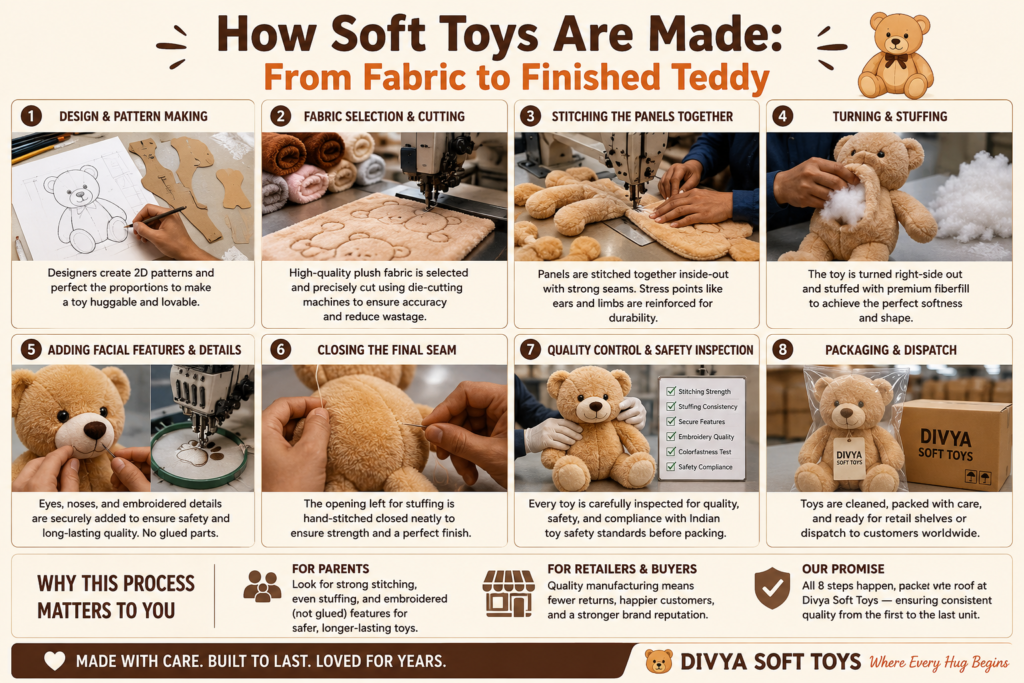
Step 1: Design and Pattern Making
Every soft toy starts as a 2D pattern — flat pieces that, when cut and stitched together, form a 3D shape. Designers work out proportions carefully here: a teddy bear’s arms, legs, head, and body panels are all separate pattern pieces before they become anything recognizable.
This stage also decides how “huggable” a toy will ultimately feel. Small changes in panel curvature can make the difference between a toy that looks flat and lifeless versus one that feels rounded and warm in a child’s arms.
Step 2: Fabric Selection and Cutting
Once the pattern is finalized, it’s laid out on rolls of plush fabric — this could be short-pile plush, minky, or velboa, depending on the toy’s intended softness and durability. Fabric is cut in bulk using either die-cutting machines or precision cutting tools, following the pattern exactly to avoid wastage.
Getting this stage wrong is costly twice over: cutting inconsistently wastes fabric, and using the wrong grain direction on plush fabric can make the fur “lay” unevenly on the finished toy.
Step 3: Stitching the Panels Together
This is where the toy starts taking shape. Skilled machine operators stitch the cut fabric panels together, almost always inside-out, so the seams stay hidden once the toy is turned right-side-out later.
Stress points — ears, limbs, and joints — often get reinforced double-stitching at this stage, since these are the areas that take the most pulling, tugging, and rough play over a toy’s lifetime.
Step 4: Turning and Stuffing
Once stitched (with a small gap left open), the toy is carefully turned right-side out. Then comes stuffing — polyester fiberfill is packed in by hand or machine, section by section, to achieve even density throughout.
This step is deceptively important. Under-stuffed toys go floppy and lose shape quickly; over-stuffed ones become stiff and lose their huggable softness. Getting the density right, and keeping it consistent across an entire production batch, is a skill that takes real experience.
Step 5: Adding Facial Features and Details
Eyes, noses, and any embroidered details are added next. At Divya Soft Toys, these are securely embedded and locked in place rather than simply glued — glued components are a common cause of choking hazards once a toy has been through a few wash cycles.
Embroidered details (like mouths or paw markings) are stitched directly into the fabric here too, since embroidery holds up far longer than printed designs, which tend to fade or crack over time.
Step 6: Closing the Final Seam
The small opening left for stuffing is hand-stitched closed — this is one of the few steps in the entire process that’s almost always done manually, since machine-closing this seam risks visible puckering or a weak point that can reopen with use.
Step 7: Quality Control and Safety Inspection
Before any toy is cleared for packing, it goes through inspection — checking stitching integrity, stuffing consistency, secure facial features, and overall finish. Toys are also tested in batches for compliance with Indian toy safety standards, covering things like colorfastness and component security.
This is the stage that separates a toy built to last from one that looks fine on day one but fails within weeks.
Step 8: Packaging and Dispatch
Finished toys are cleaned of loose threads, given a final visual check, and packed — either individually for retail or in bulk for wholesale and export orders — ready to reach a store shelf or a child’s arms.
Why This Process Matters to You
If you’re a parent, understanding this process helps you spot the difference between a well-made toy and a poorly made one — check the stitching at stress points, press gently to feel stuffing consistency, and look for embroidered (not glued) features.
If you’re a retailer or business buyer, this process is exactly why manufacturing quality control matters more than a low price tag. A toy that falls apart becomes a returned order and a lost customer.
At Divya Soft Toys, every one of these eight steps happens under one roof — which is how we keep quality consistent from the first prototype to the ten-thousandth unit in a bulk order.
Curious to see this process in person, or want samples for your own retail line? Get in touch with our team — we’re happy to walk you through it.